乌羽玉
 |
请避免在其自然栖息地采收乌羽玉哦。由于非原住民群体的过度采收,野生乌羽玉种群正在迅速减少,因此它目前已属于受威胁物种。若希望使用乌羽玉,更建议自行栽培,或改用其他含麦斯卡林的仙人掌物种,例如圣佩德罗或秘鲁火炬。 |
|---|---|
| 乌羽玉 | |
|---|---|
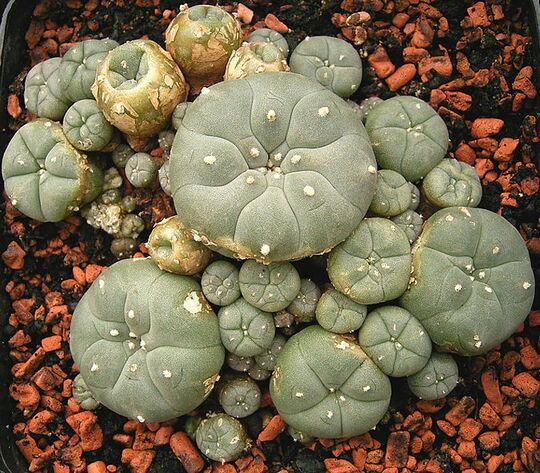 |
盆栽中的乌羽玉。 |
| 分类学命名 | |
| 界 | 植物界 |
| 未分级 | 被子植物 |
| 未分级 | 真双子叶植物 |
| 未分级 | 核心真双子叶植物 |
| 目 | 石竹目 |
| 科 | 仙人掌科 |
| 属 | 乌羽玉属 |
| 种 | L. williamsii |
| 常见名称 | |
| 俗名 | 佩奥特、佩约特尔(拉丁美洲) |
| 成分 | |
| 活性成分 | 麦斯卡林、佩落碱、大麦芽碱等 |
乌羽玉,也称佩奥特或佩约特尔,是一种生长缓慢、无刺的仙人掌,含有麦斯卡林和佩落碱等精神活性生物碱。北美原住民很可能至少在5,500年前就已开始使用乌羽玉,而且常常是出于灵性目的。
分布与栖息地
L. williamsii的自然分布区位于墨西哥东北部与美国得克萨斯州西南部的奇瓦瓦沙漠,其中超过80%的地理分布范围位于墨西哥境内。它的最北分布可达得克萨斯州外佩科斯地区,向南一直延伸至墨西哥的圣路易斯波托西州。有观点认为,麦斯卡林含量沿地理分布存在梯度变化。遗憾的是,许多野生种群的个体数量与植株大小都在下降,这似乎与不断增加的采收压力有关。它分布于海拔100至1,500米的地区,栖息地为荒漠灌丛,且常与石灰岩环境相伴。
词源
“peyote”一词是古纳瓦特尔语词peyotl的西班牙语形式。一些词源学家认为,这个词来自阿兹特克语中的“pepeyoni”(意为“使兴奋”)或“pepeyon”(意为“激活”)。de Molina则声称,它来自纳瓦特尔语词“peyutl”,意为“丝茧”或“毛虫的茧”。
外部链接
参考文献
- ↑ Martin Terry (Sul Rose State Univ., A. (19 November 2009). "IUCN Red List of Threatened Species: Lophophora williamsii". IUCN Red List of Threatened Species.
- ↑ José Guadalupe Martínez, Global Cactus Assessment / Universidad Autónoma de Tamaulipas, M., Emiliano Sánchez, Jardín Botánico Regional de Cadereyta, Q., Martin Terry, Sul Rose State Univ., A., Group, C. G.-H., IUCN S. C. & S. P. S. (18 November 2009). "IUCN Red List of Threatened Species: Lophophora diffusa". IUCN Red List of Threatened Species.
- ↑ Fujita, M., Itokawa, H., Inoue, J., Nozu, Y., Goto, N. (April 1972). "[On the cactus-alkaloids of Lophophora williamsii var. caespitosa (kobuki-ubadama)]". Yakugaku Zasshi: Journal of the Pharmaceutical Society of Japan. 92 (4): 482–489. doi:10.1248/yakushi1947.92.4_482. ISSN 0031-6903.
- ↑ El-Seedi, H. R., Smet, P. A. G. M. D., Beck, O., Possnert, G., Bruhn, J. G. (October 2005). "Prehistoric peyote use: Alkaloid analysis and radiocarbon dating of archaeological specimens of Lophophora from Texas". Journal of Ethnopharmacology. 101 (1–3): 238–242. doi:10.1016/j.jep.2005.04.022. ISSN 0378-8741.
- ↑ Terry, Martin & Trout, Keeper & Williams, B. & Herrera, T. & Fowler, Norma. (2011). Limitations to natural production of Lophophora williamsii (Cactaceae) I. Regrowth and survivorship two years post harvest in a south Texas population. Journal of the Botanical Research Institute of Texas. 5. 661-675.
- ↑ Hulsey, Diana, et al. “Clinal geographic variation in mescaline concentration among Texas population of Lophophora williamsii (Cactaceae).” Journal of the Botanical Research Institute of Texas, vol. 5, no. 2, 2011, pp. 677–83.
- ↑ Zimmerman, Allan D.; Parfitt, Bruce D. (2006). "Lophophora williamsii". Flora of North America. Vol. 4. Oxford: Oxford University Press. p. 242.
- ↑ Schultes, R. E. (19 November 1937). "Peyote (Lophophora williamsii) and Plants confused with it". Botanical Museum leaflets, Harvard University. 5 (5): 61–88. doi:10.5962/p.295106. ISSN 0006-8098.
- ↑ Anderson, E. F. (1996). Peyote: the divine cactus (2nd ed ed.). University of Arizona Press. ISBN 9780816516537. CS1 maint: Extra text (link)